

Required Reading
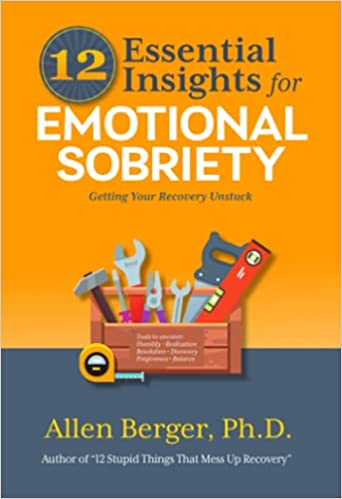
12 Essential Insights for Emotional Sobriety
by Allen Berger, Ph.D.
0
Introductory Session
- Get the book — order on Amazon.
- Read Bill W’s Grapevine article in Appendix A (pp. 303–306).
- Optional: Visit Allen Berger’s website; Read Forward (pp. 9–11) and Acknowledgements (pp. 13–15).
- Watch: Introductory Session Video ▶
1
Being Stuck and Getting Unstuck
- Read Chapter 1.
- Discussion questions:
- How does abstinence (physical sobriety) fit into your overall definition of recovery?
- Are there any ways that you are defining recovery that guarantee your inability to recover? Are you trying to force yourself to believe something you don’t, or to be someone you can’t be?
- What do you think of Berger’s line, “Trouble grows people”?
- In what ways are you overly influenced by others?
- In what ways has having expectations of other people caused you problems?
- Watch: Being Stuck and Getting Unstuck ▶
2
Exploring Emotional Sobriety
- Read Chapter 2.
- Discussion questions:
- How do you determine what your emotions are trying to tell you?
- With regard to your emotional center of gravity, what do you do to stay centered when others in your life are being negative or attacking?
- In what ways are you taking responsibility for your own emotional well-being?
- In what ways are you learning to let go of your expectations of others and of life in general?
- Take one of your important relationships and list all of the expectations you have of that person.
- Watch: Exploring Emotional Sobriety ▶
3
Waking Up from Our Sleepwalking
- Read Chapter 3.
- Complete the sentence stems on page 68.
- Discussion questions:
- Do you recognize the basic needs in yourself to be loved, accepted, and to belong? How have these needs affected your ability to recover?
- Which blueprint (expansive, self-effacing, or resignation) is your primary blueprint, and how has it affected your recovery?
- What are some of the “should demands” you have for yourself, for others, and for life in general?
- What parts of your true self have you had to cut off or put to sleep?
- Watch: Waking Up from Our Sleepwalking ▶
4
Living Life Consciously
- Read Chapter 4.
- Complete the sentence stems on pages 85–86.
- Discussion questions:
- How has awareness been essential for your recovery? How did the steps help you wake up and become aware?
- What self-limiting beliefs has your false self given you? (One of my big ones was that no one would like me unless I was who they wanted me to be.)
- How have you been sabotaging yourself with regard to your recovery? (I used to think my food had to be perfect — entire abstinence. But I finally saw that entire abstinence was about my alcoholic foods. The rest is about balance and sanity.)
- What is your internal critic preventing you from doing that would benefit your recovery?
- What are some actions you take to support yourself in your recovery?
- Watch: Living Life Consciously ▶
5
Discerning Our Emotional Dependency
- Read Chapter 5.
- Complete the sentence stems on pages 102–103.
- Discussion questions:
- How has your emotional dependency negatively impacted your self-esteem?
- How have you been emotionally dependent on important people in your life?
- How are you depending on others to validate your self-esteem?
- What are some of your unenforceable rules for life in general? Do you have any unenforceable rules for your Higher Power?
- What are some things you can do to support yourself emotionally?
- Watch: Discerning Our Emotional Dependency ▶
- Optional: Complete the Emotional Sobriety Inventory Exercise on pages 104–107.
6
Knowing It’s Not Personal
- Read Chapter 6.
- Complete the sentence stems on page 126.
- Discussion questions:
- How does taking things personally negatively affect your recovery?
- How has seeing everyone as judging you made you feel fearful and anxious?
- How do you try to read people’s minds, and how does it affect your serenity?
- What do you think of the idea that nothing anyone says or does has anything to do with you?
- When we take something personally, we connect what a person is saying to a wound we already have. What are some of your wounds that cause you to take something personally?
- How are the steps helping you to develop a stronger sense of self?
- Watch: Knowing It’s Not Personal ▶
7
Realizing That No One Is Coming
- Read Chapter 7.
- Complete the sentence stems on page 143.
- Discussion questions:
- What does the insight that “no one is coming” mean to you?
- Do you believe you are hopeless or unfixable? Why? Where did you get this idea?
- What are some of the outside things you thought were going to cure or fix you?
- If you are having trouble in recovery, do you think the problem is you, or that you just haven’t found the right path yet?
- What toxic ideas are holding you back from recovery?
- Watch: Realizing No One Is Coming ▶
8
Accepting What Is
- Read Chapter 8.
- Complete the sentence stems on page 167.
- Discussion questions:
- What are you thinking or doing that is interfering with your process of self-acceptance?
- Do you agree with Dr. Berger that much of our work in recovery is about acceptance of the world as it is? Why or why not?
- Are you in an adversarial relationship with yourself? How so?
- What are some of your expectations and “shoulds” that you need to let go of?
- Watch: Accepting What Is ▶
9
Living Life on Life’s Terms
- Read Chapter 9.
- Complete the sentence stems on page 184.
- Discussion questions:
- Are there any expectations of others or of life that you refuse to give up?
- What do you think about the difference between fear and anxiety talked about on page 174?
- Is it true for you that your expectations interfere with your ability to cope with life? How so?
- What do you think of the idea that we need to put our emotional center of gravity in our faith in ourselves and our ability to cope, rather than in our expectations?
- Watch: Living Life on Life’s Terms ▶
10
Discovering Novel Solutions
- Read Chapter 10.
- Complete the sentence stems on pages 202–203.
- Discussion questions:
- What did you think of the idea that the problem is never the problem? How does this apply to your abstinence and weight?
- Can you identify the unhelpful ways you have tried to deal with your compulsive overeating or food addiction?
- Has pausing between stimulus and response helped you with your recovery versus just automatically reacting? How so?
- Do you agree that learning to creatively solve your problems is important for emotional sobriety? Why?
- Watch: Discovering Novel Solutions ▶
11
Breaking the Bonds of Perfection
- Read Chapter 11.
- Complete the sentence stems on pages 219–220.
- Discussion questions:
- How is your perfectionism related to your fear of not being loved, accepted, and belonging?
- How does your perfectionism affect your ability to be abstinent? How does it affect the quality of your recovery?
- Are you trying to perfectly manage anyone else’s emotions or feelings? How is that working out for you?
- What kind of abusive things does your inner critic say to you?
- What can you do to let go of your expectations of perfection?
- Watch: Breaking the Bonds of Perfection ▶
12
Healing Through Forgiveness
- Read Chapter 12.
- Complete the sentence stems on page 240.
- Discussion questions:
- Do you agree that forgiving those who have hurt or betrayed us is key to dealing with our unfinished business? Explain.
- Have you had a forgiveness experience that was transformative? How did it change you?
- Can you think of a grievance story you have been telling yourself? How is your story preventing you from forgiving?
- How can you be the hero of your own story?
- Watch: Healing Through Forgiveness ▶
13
Living a Purposeful Life
- Read Chapter 13.
- Complete the sentence stems on pages 258–259.
- Discussion questions:
- How does practicing Step 12 help you continue to “peel back the onion” on your recovery and your true self?
- What do you say to sponsees who believe they are not ready or capable enough to sponsor others?
- Do you have a purpose you can pursue with your whole heart? If so, what is it? If not, what are some possible ideas?
- How does having a purpose get you out of your self-centered trance?
- Are you attracted to people in program who have a purpose? How can you be that purposeful person for someone else?
- Watch: Living a Purposeful Life ▶
14
Holding Onto Ourselves in Relationships
- Read Chapter 14.
- Complete the sentence stems on page 292.
- Discussion questions:
- What are some of your toxic rules for the loved ones in your life?
- Do you agree that demanding things go our way is a surefire way of turning any relationship into a power struggle? Why?
- How is immature love disrespectful to our partner?
- Can you see that selfish people actually hate themselves? How has this been true for you?
- Emotionally independent people love themselves. How can you help yourself to love yourself more?
- Watch: Holding Onto Ourselves in Relationships ▶
15
Paddling Your Own Canoe
- Read Chapter 15.
- Watch: Paddling Your Own Canoe ▶